Find the words in your report
Ten findings, explained.
Open a topic for its meaning, useful evidence and questions to ask. The appropriate response depends on the actual system and condition.
Cracked liner or open tile joints
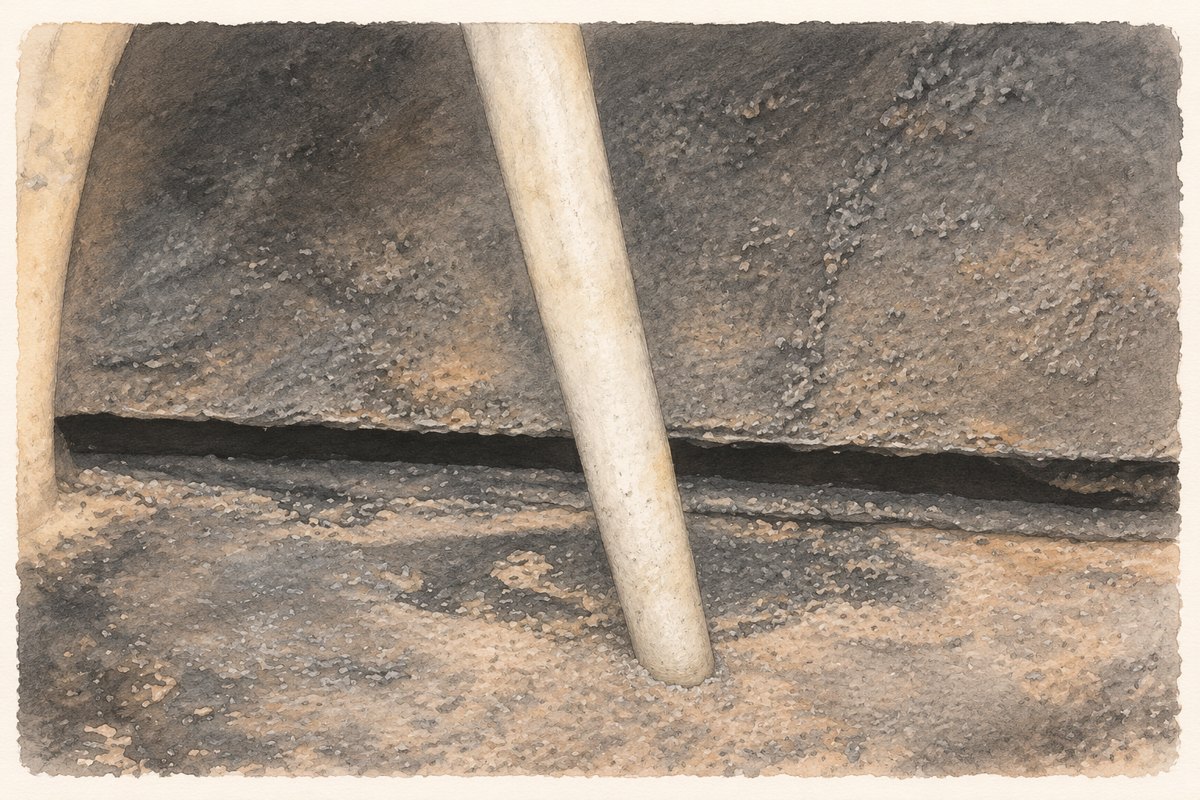
The lining forms the flue’s interior passage. A confirmed opening or missing joint material can raise a containment concern; a dark line in a camera image needs interpretation.
What supports the finding?
Ask for the affected flue, joint location, context and close-up views, and whether deposits limit the view.
What still needs context?
The finding should explain why repair, replacement or relining is proposed. One image does not select the appropriate remedy or establish every concealed condition.
Questions to ask
- What opening or damage was confirmed?
- Why does the proposed repair address it, and what will be checked afterward?
Smoke chamber needs attention
The smoke chamber connects the firebox area to the flue. The cited 2019 masonry provisions call for a smooth insulating refractory-mortar interior finish; its geometry must be evaluated separately.
What supports the finding?
Look for the location of rough surfaces, exposed corbels, voids or damage, plus measurements supporting any geometry finding.
What still needs context?
A surface coating does not establish adequate wall thickness or correct every shape problem. The 2019 height provision sets an upper limit; it does not require chamber height to equal fireplace-opening width.
Questions to ask
- Is the concern the surface, geometry or both?
- What does the proposed treatment leave unresolved?
Damaged firebrick, joints or panels
The firebox is the area containing the fire. A masonry firebox and a factory-built fireplace with refractory panels need different assessment criteria.
What supports the finding?
The report should identify the fireplace type, affected material, location and extent of damage, and the model when relevant.
What still needs context?
An unexplained repair grade does not describe the defect. For factory-built panels, a generic crack-size rule cannot replace the applicable product instructions.
Questions to ask
- Which joints, bricks or panels are affected?
- What supports localized repair, panel replacement or a larger scope?
Combustible material too close
A clearance is the separation required between a component and combustible material. The relevant provision depends on the system and location.
What supports the finding?
Ask what material was identified, where the distance was measured, the measured value and the specific standard or product instruction used.
What still needs context?
A mantel, framing beside a chimney and insulation touching a listed chimney are different situations. A flue camera cannot establish all concealed clearances.
Questions to ask
- Which requirement applies to this assembly?
- Which areas were visible, and which remain concealed?
Deposits or an obstruction
Deposits and blockages can affect the passage and hide the surface beneath them. The report should describe where they are and what was visible.
What supports the finding?
Look for the type and extent of material, cleaning or removal already performed, and any area still obscured.
What still needs context?
Cleaning and inspection answer different questions. Removing an obstruction does not, by itself, establish the condition of the previously hidden lining.
Questions to ask
- What could not be examined before cleaning?
- Will the newly exposed area be evaluated afterward?
Crown or top-tile damage
The crown covers the masonry around the flue openings. The projecting liner and its interface with the crown are separate components.
What supports the finding?
Ask for pictures locating cracks, loose material, tile damage and the crown-to-liner interface, along with the basis for the proposed work.
What still needs context?
A crown repair, rain cap and flashing repair address different parts. A visible crack alone does not prove the source of an interior leak or establish that total replacement is the only suitable option.
Questions to ask
- Which component is damaged?
- Why is the recommended repair scope appropriate?
Deteriorated shoulders or masonry
Shoulders are the sloped transitions where a wider chimney narrows. A report may identify open joints, damaged brick or stone, cracks, or movement there.
What supports the finding?
Ask for the affected face and elevation, close-up and wider views, and the observed extent of joint loss, damage or displacement.
What still needs context?
A photograph of staining does not establish a complete moisture diagnosis. Ask what supports a recommendation for joint repair, selective replacement or rebuilding.
Questions to ask
- Is the observed issue surface deterioration, movement or both?
- What evidence supports the proposed extent of repair?
Cap, flashing or water-entry concern
A cap covers a flue termination; flashing addresses the roof-to-chimney junction. They are not interchangeable repairs.
What supports the finding?
Look for the named component, observed gap, blockage or deterioration, and any investigation connecting it to the reported symptom.
What still needs context?
A stain beside a chimney can have more than one possible source. A listed vent termination also has product-specific requirements; a generic masonry cap is not a universal substitute.
Questions to ask
- What was observed at the proposed repair location?
- Was the water pathway established or is further investigation needed?
Metal liner or insulation question
A metal liner should be identified by its product and intended application. Its appearance at the top does not reveal every part of its construction or installation.
What supports the finding?
Ask for manufacturer/model information, the relevant instructions, insulation construction and any measured or unverified clearances.
What still needs context?
Some liner assemblies contain factory-installed insulation. A bare-looking surface is not enough to decide whether the required insulation is present or whether the installation complies.
Questions to ask
- Which liner system is installed?
- What specific requirement is unmet or still unverified?
Furnace or water-heater venting
A utility-vent finding needs the appliance and venting arrangement identified. Separate flues in one chimney are different from appliances connected to a common vent.
What supports the finding?
Look for the appliances’ fuel, category and input, the connector arrangement, vent dimensions and height, and the sizing method used.
What still needs context?
A fireplace flue-area ratio is not a gas-appliance sizing method. NFPA 211-2019 points to NFPA 54 for gas sizing; the applicable appliance and vent instructions also matter.
Questions to ask
- Which appliances and connections are included?
- What sizing and compatibility information supports the recommendation?
Questions about your report
Scope and inspection levels
Does one chimney report cover every fireplace and appliance?
Check the system list and scope. A single masonry stack can contain several flues serving different fireplaces or appliances. Ask which were included, which were excluded and why. Whether that scope is appropriate depends on the circumstances and applicable requirements; the word “chimney” alone does not answer the question.
What do Level I, II and III mean?
They describe inspection scope, access and invasiveness—not dirtiness or a safety score. In the 2019 edition, Level I addresses readily accessible areas under continued-use circumstances; Level II adds accessible areas and internal flue evaluation; Level III investigates necessary concealed areas when the concern cannot be resolved at the earlier levels. Ask which edition and trigger support the level stated in your report.
Does a camera scan make it a Level II inspection?
Not by itself. A camera is one method of examining the flue interior. The inspection level also involves the reason for the visit, areas examined and access. Ask what the camera covered and what other parts were evaluated; a video file alone cannot describe that complete scope.
What does “not inspected” mean?
It means the report does not establish that area’s condition. “Not applicable” means the item does not apply to that system; “no defect observed” describes the examined area within the stated limits. Ask why access was limited and whether additional examination is needed. An empty checkbox should not be read as approval.
Findings and evidence
What makes a photograph useful?
You should be able to locate the photographed component and understand what the inspector wants you to notice. A system label, wider context view and detail image often help. Measurements need units and clear endpoints. NCSG encourages homeowners to ask for a written report and photographs; a fixed number of images does not establish inspection quality.
Should I receive the entire camera video?
Ask what the inspection agreement includes. The use of a camera and delivery of a complete recording are different matters. Clear images, location references and written findings can help you understand the result; if a brief frame is ambiguous, ask for additional context. This guide does not treat full-video delivery as a universal NFPA requirement.
What should “not to code” explain?
Ask for the observed condition, the relevant measurement or evidence, and the applicable document, edition and section. A product manual may be central for a listed system. A national standard’s newest edition is not automatically the edition adopted by your municipality, and the treatment of an existing installation needs its own assessment.
Does a sweeping receipt mean the system passed inspection?
No. It records work, but you still need to know what inspection was performed and what it found. Cleaning can improve visibility without establishing concealed clearances or resolving existing damage. Ask for the inspection scope, observations and any areas still awaiting evaluation.
Recommendations and next steps
Does a defect mean the recommended repair is the only option?
Not necessarily. Ask why that remedy suits the confirmed condition, the particular system and the applicable requirements. Other approaches may be unsuitable or unavailable, but the report and proposal should explain the connection. A less expensive option is not automatically appropriate, and a larger repair is not automatically unnecessary.
Why might the inspector recommend further investigation?
Deposits, limited access, concealed construction or uncertain product identification may prevent a reliable conclusion. Ask what question remains unresolved, what access or method will answer it and how the result could change the repair scope. Further investigation should have a purpose that you can understand.
Why do two inspectors recommend different work?
Compare the systems examined, access, evidence and assumptions before comparing prices. One report may include information the other does not. Ask each inspector to connect the proposed work to specific findings and explain any disagreement. A second opinion is most useful when it considers the actual report and relevant site conditions.
Can I keep using the fireplace while deciding?
Find the report’s operating direction for that specific system. If the inspector has said not to use it, do not treat this guide or an online image discussion as permission to resume. Ask what must be evaluated, corrected and verified before operation. If the direction is unclear, clarify it with the inspecting professional before use.
What should I keep after the repair?
Keep the original findings, agreed scope, relevant product information, completion records and any follow-up assessment. Ask which finding each repair addressed, how completion was checked and whether anything remains inaccessible or unresolved. Completing one repair does not silently close every item in the original report.
Can House & Flue help me understand a report?
Use Ask a professional to send a focused question with the relevant report pages and photographs. Include the wording you want explained and the system it concerns. A response can clarify terminology and useful questions; it cannot establish concealed conditions or replace an on-site inspection.
Terms you may see
- Flue
- The passage that carries combustion products away from a fireplace or appliance.
- Liner
- The material or system forming the inside of that passage.
- Smoke chamber
- The transition above a masonry fireplace firebox leading toward the flue.
- Parging
- Applying a mortar coating to a masonry surface; a report should identify the location, material and purpose.
- Crown
- The top covering of masonry around the chimney’s flue openings.
- Flashing
- The roof-junction detail intended to manage water where the chimney passes through the roof.
- Clearance
- The separation applicable to a component and nearby material, established by the relevant requirements.
- Listed system
- A product or assembly evaluated for identified uses and installation conditions; its specific instructions matter.
Keep beside your report
Questions to keep with your report
Use this as a reading worksheet, not a checklist for inspecting the chimney yourself. Complete one finding at a time.
Open the printable worksheetA question about your report?
Send the relevant pages and tell us which finding or recommendation you want to understand.
Ask a professionalSources and editions
Technical references below identify NFPA 211’s 2019 edition. They are not a determination of current local requirements. NFPA now lists a 2027 edition; its full provisions have not been reviewed for this guide. Product instructions and the applicable local requirements also matter.
Source review: November 24, 2026. Report layouts, questions and worksheets are original editorial aids.
- NFPA 211, 2019 edition — inspection scope§§15.1–15.5; printed pp. 211-47–49. Supplied 2019 text reviewed. The link leads to NFPA’s edition/access information, not a public copy of the supplied book.
- NFPA 211, 2019 edition — maintenance and deposits§§14.2–14.9 and 15.3.2.4; printed pp. 211-46–48. Inspection, condition-based maintenance, damage and visibility are distinct.
- NFPA 211, 2019 edition — liner condition and installation§§7.1.10, 7.2.2.3, 7.2.10, 7.2.12.3, 7.3.2 and 14.9; printed pp. 211-22–25 and 47. Applicability and listed-system conditions must be retained.
- NFPA 211, 2019 edition — masonry fireplaces§§11.2.1.4–11.2.1.13; printed pp. 211-36–37. Chamber geometry and smooth refractory-mortar finish are separate provisions.
- NFPA 211, 2019 edition — clearance context§§6.4, 7.3, 11.2.5.3–11.2.5.4 and 15.4.2; printed pp. 211-20, 25, 38 and 49. No universal distance is prescribed by this guide.
- NFPA 211, 2019 edition — listed systems§§6.1.1, 11.1.1 and 14.7.1.1–14.7.1.2.1; printed pp. 211-19, 36 and 47. Manufacturer instructions and applicable approval provisions matter.
- NFPA 211, 2019 edition — top tile and crown interface§§7.2.13.3–7.2.13.4; printed p. 211-24. Supports distinguishing the liner projection and accommodation of movement; it does not establish the source of a particular leak.
- NFPA 211, 2019 edition — chimney caps§4.6; printed p. 211-15. Cap and spark-arrester provisions have conditions; listed terminations need their applicable instructions.
- NFPA 211, 2019 edition — appliance suitability and sizing§15.4.2.5; printed p. 211-49. Refers gas-appliance sizing to NFPA 54 and liquid-fuel sizing to NFPA 31. This guide does not provide sizing calculations.
- NFPA 211, 2019 edition — existing installations§§1.3–1.4; printed p. 211-5. Retroactivity and equivalency require appropriate application; no municipal adoption determination is made here.
- NCSG — questions to ask an inspection companyHomeowner guidance includes asking for a written report and photographs. It does not prescribe every field in this guide.
- DuraVent — DuraLiner installation instructionsModel-specific example: factory-insulated rigid construction and separate flexible-section insulation instructions. It does not establish the suitability of an unidentified liner.
- House & Flue — reading a findingThe report example, worksheet and questions are original editorial aids. They are not an NFPA report form, a prescribed photo count or an inspection certification.
- Brick Industry Association — brick masonry maintenanceTechnical Note 46 (2017): document conditions and determine the source of moisture before choosing repairs. Masonry guidance, not a local code determination.
- Brick Industry Association — corbels and chimney shouldersBrick Brief (August 2025), chimney-shoulder discussion. Component and water-shedding context; not a repair specification for a particular house.